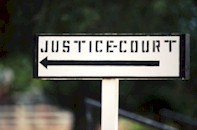
I wander back into the empty courtroom. I’m still not sure what to make of it all.
I think of the ceremonial pomp that courts have traditionally used to impart a sense of their authority. The image of robes and wigs comes to mind. Here, they would get no farther than that coat tree over by the door—the one with the broken hook.
People in Elk Grove are down-to-earth in a way that suggests remarkable insight. If they had built the United States Capitol, would it be distinguishable from any office building or school?
It is an unsettling prospect.
Democracy is an unsettling prospect.
I think of the young man who may be sent to prison next week. The twelve men and women deciding his fate will be essentially whoever the clerk and constable can round up. They won’t be a great pool of legal acumen.
I've been told that Clarence Darrow, or one of the old greats, used to distract the jury from his opponent’s summation by smoking a cigar with a wire inside, to keep an ever-lengthening ash from falling. Will next week’s jury be immune to slick ploys?
But I think back to the first jury trial I ever attended. I’d watched a televised episode of The Six Wives of Henry VIII the night before it opened, and after all the intrigues of the aristocratic court, the process of swearing in the neighborhood pharmacist and lunch-counter waitress and garage mechanic to look at some evidence was an undeniable improvement.
In its way, it was majestic.
My gazes wanders over Justice Court’s green concrete-block walls...past the brown stripe where the back of the judge’s chair has rubbed...over the map of California put out by the Farmers & Merchants Bank...
On a whim, I check the American flag in the corner.
It has 48 stars.
There’s as much respect now as there is amusement. And there’s an odd sensation—something like homesickness.


