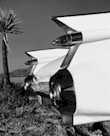
Cooties have had a profound impact on automotive evolution. For example, when large American luxo-cruisers got the cooties, their doom was sealed.
When, exactly, was this condition contracted? Although many people would tie the event to the Arab oil embargo of 1973-74, I'm more inclined to locate the seeds in the late sixties.
Up until the late sixties, a few magazines specializing in the purveyance of pictures of Ferraris and Maseratis and Lotuses and Aston Martins--i.e., upper-end autoporn--turned up their noses at American cars. Hardly anybody outside a small group of sports car fanatics were all that concerned with what these magazines said, though.
Then the Revolution happened. And with the Counterculture came a perception of large, opulent freeway cruisers as "Establishment" cars.
At about the same time, a lot of American young people spent time kicking around in Europe. Here they could hardly fail to notice how much smaller the cars were. If they commented on this difference, the locals would point out how nimbly their vehicles negotiated the winding, curvy roads of the Continent--compared to which, American cars were hopelessly floundering lummoxes.
In the same process, the young people were also likely to hear that their parents' big, chrome-bedecked luxo-cruisers represented the quintessence of American crassness and vulgarity (i.e., that they had the cooties). And in the time-honored tradition of affluent American naifs abroad among part-sophisticated, part-just-plain-jealous Europeans, the travelers bought into the criticism.
Now, not every young person who spent time in Europe was heavily enough into the Counterculture to feel comfortable berating American cars as being too "Establishment." But virtually anyone who had any basis for comparison could feel comfortable describing Detroit's products as lacking in agility. So large numbers of us, taking our cue from the likes of Car and Driver and Road & Track, began expressing our misgivings about conventional American cars primarily in terms of their deficiencies in cornering and handling.
There was absolutely nothing inaccurate about this criticism. And it certainly did sound more sophisticated to talk about cornering than to talk about cooties. But the cornering issue came up a bit short on practical relevance to American needs.
Most American roads are, after all, pretty much straight. In fact, there are whole areas of the country--places like Iowa and Texas come to mind--where you'd have to search very diligently to find a place where you could turn the steering wheel even a little bit, except onto an intersecting road or into your own driveway. Also, even when we can find curving roads, these have speed limits, which are deliberately set at levels that eliminate any hope of a motoring challenge. We also tend to do most of our driving in traffic, where no matter what we're in the cockpit of, we can't go any faster than the guy ahead of us in the Old Fogeymobile.
The old-style large American car, with its long wheelbase and soft suspension, was actually pretty well adapted to this kind of driving. In fact, it was in many ways better adapted to such conditions than many of the newly fashionable imports are. For example, the old-style luxo-boat tended to be more serene in an encounter with a pothole--and if it got damaged, it was cheaper to re-align than its Euro-counterpart with four-wheel independent suspension.
Thus, if we're looking for a way in which old-style American luxo-boats fell short of consumers' requirements (as opposed to missing the ever-changing nuances of taste), we'll have to consider something beyond the way they met our practical driving needs.
Where else to look?


